I'm literally the only person who cares, since (as established many times) all my readers are imaginary. If somehow one of you is not imaginary and forgot to tell me, this is for your benefit too, I guess. Also if anyone happens by this blog on an accidental google search and for some unaccountable reason likes what I write and wants more.
I'm not the same person who started this blog, almost seven years ago. And that's a good thing, too; it would be pretty fucking sad if my thought process hadn't changed since I was 18. Most of things I complained about in this blog now don't really bother me, or at least I wouldn't care enough to write about. Many of the thoughts I've posted I've since changed my mind about, or restated in different ways, or don't seem relevant anymore.
This once tried to be an atheist blog. I'm still an atheist, but that seems much less important. That one question has been answered, let's move on.
When I realised how limited the atheist memespace was, I tried my hand at scepticism in general, and later on the rationalitysphere. I'm still working that last one, but the work I have here is not really a good example of that (especially everything before I read Less Wrong, but a good deal of what's after as well).
At one point this tried to be a writing blog; clearly that failed, and although I intend to go back to that, I've been "intending to go back to that" on and off for years. No reason to expect this time will be the one. And all the fiction I've posted here sucks, but I knew that even back then.
The point is: when I read back, I cringe a bit. I think that's about as healthy a reaction as one can have to a younger self. I've posted here a bit recently, testing the waters, but there's no reason to keep at it.
I have a Tumblr account now, which I got basically because it was a convenient way to follow some people. Still, having it empty bothered me, so I started using it. I've since posted a couple of longer form things I would have usually posted here. Which means, I have a platform for thinking out loud that isn't burdened with my past dumb stuff (yet!).
So yeah. It would seem Untheism is no more. I liked it while it lasted.
As a final note, if for some reason you need to interact with my online presence, I'm on twitter, the aforementioned tumblr, and I'm usually hanging out on the forum I admin, FQA. Also, anyone using the name "Sigmaleph" anywhere on the internet is probably me.
Bye!
Showing posts with label English. Show all posts
Showing posts with label English. Show all posts
Friday, January 16, 2015

Monday, January 5, 2015
Death is bad, 2
I fully expected the last post to be a one-shot, but then Scott Alexander wrote a thing on ethics offsets:
Some people buy voluntary carbon offsets. Suppose they worry about global warming and would feel bad taking a long unnecessary plane trip that pollutes the atmosphere. So instead of not doing it, they take the plane trip, then pay for some environmental organization to clean up an amount of carbon equal to or greater than the amount of carbon they emitted. They’re happy because they got their trip, future generations are happy because the atmosphere is cleaner, everyone wins.
We can generalize this to ethics offsets. Suppose you really want to visit an oppressive dictatorial country so you can see the beautiful tourist sights there. But you worry that by going there and spending money, you’re propping up the dictatorship. So you take your trip, but you also donate some money to opposition groups and humanitarian groups opposing the dictatorship and helping its victims, at an amount such that you are confident that the oppressed people of the country would prefer you take both actions (visit + donate) than that you take neither action.
The concept is probably unappealing to a certain sort of person, but not me. My sort-of-utilitarian, definitely-consequentialist mind is 100% on board with the idea. Or at least, it was, until:
GiveWell estimates that $3340 worth of donations to malaria prevention saves, on average, one life.
Let us be excruciatingly cautious and include a two-order-of-magnitude margin of error. At $334,000, we are super duper sure we are saving at least one life.
So. Say I’m a millionaire with a spare $334,000, and there’s a guy I really don’t like…
(Scott further specifies that you are a master criminal that will never get caught, it looks like death by natural causes so you don't waste police time, etc. or that you further offset those costs with more and more donations, as one in principle could)
So. As is its wont, my brain broke down on that one. One part of my mind says "Well, which world would you rather live in? The one where this mysterious millionaire didn't save all those lives, at the expense of killing one person? By any reasonable standard, that's a better world to live in: if death is bad, then saving lives is good, and saving more lives is better" The other part mostly yells "but murder is bad!".
The key insight here, as far as I can tell, is that my intuitions on morality break down somewhere in the vicinity of murder. I can be OK with the idea of killing one person to save many others (e.g. the trolley problem) because you didn't put the person in the tracks. I can even be OK with the fat man version of the trolley problem, because it's not your fault that's the only way to save five people. But I'm not OK with this. Where's the difference?
The obvious candidate is "But you have another available course of action: not murdering anyone, and donating the money anyway. That's clearly better." And that's true, and if true it applies equally to all ethics offsets, not just re: murder. And I agree: if it comes to me, the obvious ethical decision is not to murder anyone and donate almost all my money to the most efficient charity. No question. But people don't actually do the most ethical action if it's too inconvenient.
Suppose I am building an ethics system to be used by imperfect humans, and some of those humans happen to be murderous millionaires. Suppose that those murderous millionaires would obey "don't murder anyone" as a rule, and would also obey "If you want to murder someone, donate X amount of money to charity to offset you murder", but they would not accept "Don't murder anyone, and also, donate all your money to charity". Sitting in this position, it seems to me, my brain can relax and think right: this is a trolley problem. The trolley was set in motion by some very peculiar quirks of the psychology of hypothetical millionaires, but it's no less trolley-ish. I still have several lives on one metaphorical track, and one on another. Sucks for the one.
I'm not sure what this means for the problem I discussed last post, (i.e. a good way to ground "killing people is bad" without resulting in life maximization), other than further confirmation that I can't trust my intuitions on killing people to be consistent.
Friday, January 2, 2015
Death is bad (but I'm not sure why)
(thoughts prompted by this post on utilitarianism and abortion)
I would urge you to read the linked article on its own, especially if you self-identify as an effective altruist or utilitarian or somewhere on that philosophical area. But for the purposes of this blog, there's an argument there that goes like this: Murder is very bad. Most people who support abortion are sure that killing a 1st trimester foetus is not murder, but they should also be aware that there a lot of people who disagree with them. Therefore, they should not be 100% certain* that abortion is not murder. Therefore, if you admit something like a 1% chance that abortion is in fact murder, and therefore very bad, and if you put numbers on "very bad" (that's where the utilitarianism comes) it's very hard to make the math come out "abortion is good". (unless you are dealing with extreme cases like abortion to save the life of the mother/foetus will not survive/etc.)
Political disclaimer: My support for legal abortion has less to do with "abortion is morally good" and more with "abortion will happen anyway but if legal it's safer" and "we should probably give people the right to decide how their body is used as a matter of principle, even if they will decide to do bad things with them". "If it's bad it should be illegal" is not a principle I endorse in the general case. So no, I'm not trying to make or endorse an argument for banning abortion.
Back to the argument. There a number of obvious responses, like:
"I'm not an utilitarian and I don't think you can do math on life and death", in which case I would love to have a longer argument with you on the subject but this post is not the place, or
"I am, in fact, very much certain that foetuses are not people and killing them is not murder, less than 0.01% chance I'm wrong", or
"Well, obviously in conclusion abortion is wrong", which I think are both interesting positions and I'll address in a moment.
In the "put numbers on very bad" part above, the author uses Quality-Adjusted Life Years (QALY). The argument is that if it turns out abortion is murder, it costs the foetus ~76 years of life, on average. Here's the part where my brain, and my philosophy, goes nuts:
What if a foetus isn't a person? Aren't we missing out on exactly those same ~76 QALY anyway?
There's a philosophy that says no. You can only care about real people, not potential people; those 76 QALY only matter if the person who would have lived them already exists.
If you accept that, yay. You can go back one level to the previous argument and try to figure out the expected personhood of a foetus, which I'm sure must be a barrel of laughs. My problem is that I'm not sure I can.
If I'm certain of anything in meta-ethics, it's consequentialism: the idea that "good" or "bad" is about states of the world. The right action is the one that results in the best state of the world, and nothing else. Not which laws you follow, not which virtues you exercise, just how the world is.
In particular, if "person X exists" is a good state of the world, we should bring it about; if not, we shouldn't. But the "fuck you, potential people" principle says otherwise: If you already exist, then states of the world where you don't mean you were killed, so that's bad. But if you don't already exist, then states of the world where you don't exist are neutral. There's no reason to care about you in the future if you don't exist now.
It seems like a very weird twist on consequentialism: The same state of the world can go from good to bad depending on when you ask the question. That's a very ugly feature I don't really want in my metaethics.
But if you reject that, not only do you have to worry about abortion, but suddenly everything from contraception to not having sex falls in the same bucket: You are not taking action to make a person come into existence, this is the same as taking action to remove a person from existence (since they both result in world states where a person doesn't exist), ergo you are a murderer.
Which brings us to a nasty conundrum: If I want to be remotely consistent about ethics, then either I admit that murder is not always that bad, or I have to stop blogging right now and go impregnate as many women as possible. Since the second option sounds like a lot of work and would probably end badly for everyone involved (except our future children, who are being saved from counterfactual murder!), let's look at the first one.
Why is killing people bad?
... honestly, I'm not sure. I'm far more certain of the fact of "don't murder" than of any philosophical justifications for it, presumably because hominid brains evolved to have an innate sense of morality where we don't kill each other all the time, because social animals that kill each other all the time don't really work too well.
Like, there's the making people sad argument: if I kill you, your friends and family will be very sad, and making people sad is bad, therefore don't do it. And that's all well and good, except that if that's all it should mean it should be alright to kill people with no friends, or people who have lots of enemies who would be happy to seem the die. It does seem to allow not having sex, since people who don't exist yet don't have friends to care, so that's at least a point in favour.
There's the preferences argument: as a general rule, people's preferences being fulfilled is good, all other things being equal. People prefer not to die, ergo, don't kill them.
But that falls prey to the potential people problem just as well: hypothetical people would most likely also enjoy existing, ergo, if we care about their preferences we should bring them into being. Should we only care about the preferences of people who exist right now? If so, then that raises intriguing questions about the future: are we supposed to stop caring about what happens to the planet after the last currently-living person dies? After all, the people who would be alive then have no moral weight right now.
It seems to me that I intuitively care about people who don't exist, like, I would think it's very bad if the world a thousand years from now is every human being living a miserable existence. But I don't worry about my potential children not existing. My brain parses "not existing" and "it existed and then stopped" as very different things, even though the end result is the same.
It would then seem there are two choices:
Existence is not inherently valuable, and I need a good ethical grounding for why murder is bad that I don't have,
or,
We are morally obligated to maximise the number of people who exist, and will exist.
I'm currently defaulting to the first one, hence the title. This just might be because the second one is weird and uncomfortable, and I would really like a good answer for this. But I don't have it.
*As a general rule, you should not be be literally 100% certain of anything, for reasons I may have gone over in the past. Here though, I don't mean just "technically this could all be an illusion created by a trickster demon" but "There is a small but measurable chance you are wrong".
Sunday, March 16, 2014
More alpha-negatrons!
Pal Sahota apparently found my previous post and may have taken offence at me using the words "crackpot physics" to describe his hypothesis. Over Twitter, he asks:
@sigmaleph Has @google paid you? Over 8900 views & many Profs & Phd's re-tweeted it. Its a hypothesis & could be wrong.Your qualifications?
— Pal Sahota (@searchasyoutype) March 15, 2014
I would've replied through the same medium, but I find the character restriction rather, well, restricting.
So, point 1: No, Google hasn't paid me. Presumably this question was prompted by the fact that he claims he invented search-as-you-type and Google stole it from him. My post was purely for the love of making fun of bad physics and there were no venal interests whatsoever.
Also, if Google wanted to discredit him, I'm sure they could've found someone with a much greater audience than me. My readership is largely non-existent.
Point 2: What does the number of views have to do with anything?
Point 3: Were any of those professors and PhDs physicists? That seems relevant. Also, a retweet is not an endorsement.
Point 4: It could be wrong, yes. Further, it actually is wrong. Of that I have already spoken.
Point 5: I don't have a degree in physics yet, though I'm working towards one. Thus, the only qualification I claim is that I know much more about physics than Pal Sahota.
This is evident by looking at his theory. The very format of his argument is flawed, relying overtly in qualitative verbal arguments rather than quantitative mathematical reasoning. There's exactly one equation in the entirety of the alpha-negatron document, Einstein's famous E=mc2, and his attempt to fit it into his theory is severely flawed (I elaborate on that in my previous post, see the second bullet point)
Anyone actually doing physics would, at the very least, make some rough calculation showing, for example, that the alpha-negatrons actually do mediate an interaction of the same order of magnitude as gravity (or any other of the millions of effects he attributes to his pet particle). That he doesn't means he either can't do it, or he doesn't even know what a physics theory looks like.
Anyone who were to seriously propose a theory in physics would, at the very least, get past the 19th century. His particle is clearly classical in behaviour, ignoring pretty much everything in quantum physics except for occasional lip service.
And that's just the generalities of the thing. I brought up plenty of specific mistakes even a lowly physics student like myself should catch, like claiming light is a longitudinal wave or ignoring that the mass/proton number ratio is not constant in all elements (or between different isotopes of the same element). I even provided references to famous experiments that invalidate his theory, like the Michelson-Morley interferometer or Millikan's oil drop.
Those are my qualifications, Pal Sahota. You're welcome to challenge them.
Monday, March 10, 2014
Alpha Negatron
Anyone up for some crackpot physics? No? Just me then.
Pal Sahota has a theory that he claims unifies "gravity, magnetism, electromagnetic radiation and time", which is nice. Someone should probably let him know that magnetism and electromagnetic radiation have been unified for a while now, but still.
I took the liberty of looking over this document up on scribd, and I noticed a few odd things, so I decided to give him a hand with some constructive criticism.
So, Pal's bright idea is that, by studying nature, he noticed " there is a basic pattern like fractal which keeps repeating itself" and therefore space isn't empty. He doesn't say what that pattern is yet, but we'll get to that later. Anyway, space isn't empty, because it's filled with particles he calls "alpha negatrons", which as far as I can tell are like the pre-quantum idea of the electron except a lot smaller and with a proportionally smaller charge. He actually says it's "infinitely smaller", but that would mean it's charge is zero and could not do all the wonderful things it does. I'll assume "infinitely" was figurative and it's simply much smaller, though it sure would be nice to have an order of magnitude.
Anyway, these alpha negatrons are negatively charged (hence the name) and so they repel each other. Pal seems to think these would lead them to arrange themselves in an evenly spaced 3D matrix, which seems odd because all the other negative and positive charges (like protons and electron) would be guaranteed to disrupt that, but sure, whatever. Frankly his argument is irrefutable. I'd guess my first question would be why negative charges much smaller than than of an electron didn't irrevocably screw up Millikan's experiment1, but I'm sure Pal can explain that.
Next, Pal says that the nucleus of the atom and the electron spin around themselves by analogy to the solar system, which is that fractal pattern he mentioned earlier. Of course, there is the minor problem that the planetary model of the atom is wrong and has been obsolete for 90 years or thereabouts2, but it's an understandable mistake. After all, popular images of the atom are still using the planetary model, and you could hardly expect someone to go study physics beyond a pop-sci level when they are so busy developing revolutionary new theories. He's also somewhat liberal in his use of the word "fractal", when referring to a pattern that appears twice (or once) as opposed as to at infinitely many levels of resolution. But other than completely ignoring all of physics after the 1920s there's not much to nitpick here. Oh, right, there's also the fact that we know that the premise being pushed is known to be wrong, also because of that pesky quantum physics3. But that's it, at least until the next few sentences of the paragraph.
There, Pal tells us that the nucleus is "infinitely larger" than the electron (once again being figurative, I'd guess) and that's why it has a much greater influence on the alpha negatrons. I would nitpick and say that being that the interaction with the ANs is electromagnetic, the fundamental property that matters is not "size" (whatever that means in this context) but rather electric charge, and that is in fact very similar in both parts of the atom4. But I'm sure this won't affect his theory greatly.
When the time comes to explain electromagnetic radiation, Pal says that "Similar to sound waves, electromagnetic waves propagate through the alpha-negatron matrix utilizing compression and rarefaction", which is not quite right. First, because we know that electromagnetic waves propagate through the electromagnetic field, and if they had a medium like the AN matrix we would've noticed5. Second, because sound waves are longitudinal but electromagnetic waves are transverse, i.e. they do not propagate through compression and rarefaction of anything. If they did, we would not have polarization of light. But this fundamental misunderstanding of the basic nature of electromagnetic waves should not cause one to doubt the soundness of the theory.
Next in this parade of explanations is gravity, which Pal describes as a fundamentally electromagnetic phenomenon where protons attract alpha negatrons which attract other protons, and thus matter with protons attracts other matter with protons. Also waves. Curiously absent is an analysis of how the electrons in matter with their negative charges would interfere with this, or any order of magnitude calculation to show this would result in the gravitational constant we see, or any math of any other kind for that matter. But this is physics, why would we need to get maths involved?
Pal is clever enough to explain that gravity appears proportional to mass because the number of protons increases with mass, which is almost true. He fails to account for the fact that different elements (or different isotopes of the same element6) have different ratios between charge and mass, so we should observe varying ratios between weight and mass depending on chemical make-up of objects. But this difference would be small and if there's something we know is that precise measurement is kind of a "meh" thing for scientists.
As if all those explainings were not enough, there is a quite extended treatment of magnetism which is so undoubtedly correct it's not even worth detailing, except to mention it's based on "whirlpools" of alpha negatrons and completely disregards electromagnetic theory on what should happen to charges in motion. But then, what has standard electromagnetic theory accomplished, other than being generally considered one of most successful theories in physics and the template all field theories are modelled after? Surely alpha negatron supersedes it in every aspect.
Pal even takes a crack at wave-particle duality in the photon, explaining it away by saying that it doesn't exist, and boldly asserts that in alpha negatron theory energy travels in wave packets. It seems curious that he borrows this property from quantum theory without bothering to explain why it should be so in alpha negatron theory. It hardly seems worth mentioning that the photoelectric effect cannot be explained through classical waves (such as those in AN theory), which is one of the reasons quantum theory was developed and the idea of the photon came about. I cannot wait to see how he will most definitely account for this.
During his conclusion, Pal takes a tour of all the complex physical phenomena his theory sorts out. These are just a few examples:
Frankly it seems there's nothing alpha negatrons can't explain. I'm sure they could even explain things that aren't actually true, because that's just how great alpha negatrons are.
In summary, I wholeheartedly and without reservations recommend alpha negatron theory be considered an unqualified success as a unified theory of everything, and frankly it's a crime Pal Sohata doesn't already have one or two Nobels in physics.
1 Millikan showed that electric charges always appear as the multiple of a certain charge, which was determined to be the charge of a single electron. If something with a much smaller charge was around, we'd expect to see things a much more continuous range of charges, rather than the discrete separation we observe.
During his conclusion, Pal takes a tour of all the complex physical phenomena his theory sorts out. These are just a few examples:
- The speed of light is constant because the separation between alpha negatrons in the matrix is constant (certainly not invalidated by the fact that alpha negatrons could not possibly remain at fixed distances around charged particles)
- E=mc2. Isn't it just a huge coincidence that the speed of light would show up there? Well, alpha negatrons save the day again, by saying that the transference between energy and mass happens through the AN matrix so the speed of light shows up. I don't see the point in bringing up that the equations for special relativity were in fact trying to explain why electromagnetic waves behave as they do so it's quite natural that the c factor would appear. Much less, that saying that the rate of transference determines the proportionality constant is somewhat like saying that the exchange rate from dollars to euros is determined by how fast the transaction is processed.
- Relativity and the effects of gravity on time. The rate of passage of time depends on how fast things move through the alpha negatron matrix, which varies because gravity is protons!
- The quantification of electron orbitals! Because alpha negatrons create forces that balance out exactly at the specified orbitals for no reason given!
Frankly it seems there's nothing alpha negatrons can't explain. I'm sure they could even explain things that aren't actually true, because that's just how great alpha negatrons are.
In summary, I wholeheartedly and without reservations recommend alpha negatron theory be considered an unqualified success as a unified theory of everything, and frankly it's a crime Pal Sohata doesn't already have one or two Nobels in physics.
1 Millikan showed that electric charges always appear as the multiple of a certain charge, which was determined to be the charge of a single electron. If something with a much smaller charge was around, we'd expect to see things a much more continuous range of charges, rather than the discrete separation we observe.
2 Quantum mechanics shows that electrons can't be thought of as tiny balls orbiting around the nucleus because they aren't tiny balls at all and they don't have a defined position and momentum.
3 There is a quantum mechanics thing called spin, which people thought at one point had something to do with the nucleus or the electron spinning around themselves, but was later shown to be fundamentally different.
4 Depending on the element, the charge of the nucleus can be identical (Hydrogen) or about a hundred times greater (elements at the end of the table) than that of one electron. And electrons usually don't show up alone, but rather atoms tend to have enough electrons to balance out their nucleus.
5 Here I refer to the Michelson-Morley experiment, which attempted to detect what was then called the luminiferous aether, a proposed medium for electromagnetic waves that was disproved and led to the development of special relativity by this fellow named Albert Einstein. If the AN matrix was a medium for electromagnetic waves, Michelson would've detected it in his experiment.
6 An isotope is an atom which has the same number of protons but different number of neutrons as another atom. For example, a regular hydrogen nucleus is just one proton, but in a deuterium nucleus there's also a neutron. If those neutrons didn't matter gravity-wise, all isotopes should weigh the same and, for example, heavy water (where the regular hydrogen is replaced by deuterium) should not be heavier than regular water. Someone might want to look into that, see if we'll have to change the name.
Tuesday, July 17, 2012
The power of the human soul
"Oh yes, the complex is entirely self-sufficient. Food, water treatment, electricity, we handle it all ourselves. Right here in this very building, as a matter of fact"
"Is that so? How exactly do you manage that?"
"Well, we harness the power of the human soul.This structure is the result of years of hard work, of research, of trial and error. I've lost track of how many designs I tried until I settled on this one, but it's paid off, let me tell you. It's the largest, most efficient soul distillery in the world!"
"Soul... distillery?"
"Of course, the process has little to do with distillation in the technical sense, but the name has stuck. That large tower in the middle houses an aether vortex of billions of souls, which are progressively run through a series of subsystems which ultimately provide all we need to subsist."
"What?! How?"
"The main product of the process is a sort of nutritious sludge, obtained from the deepest essence of the souls. The necessary steps are mostly a series of filters inscribed in runes of ancient power and a centrifuge and some, um, other steps, but anyway, in the end we get our main food source. It has some wonderful properties, it's healthy, and filling, and has some curious side-effects at the, uh, higher concentrations some of us take"
"I'm sorry, you're telling me you eat souls-"
"Not just eat, no, like I said earlier, the sludge's just one of the products of the system. The vortex functions as a turbine, too, that's how we power the complex, and there are other byproducts of the refining of the soul we take advantage of for various purposes. Fertilizers for what little farming we do, building materials, disinfectants, some other things..."
"But, I... you mentioned billions of souls, right? How does that even work, where do the souls come from?"
"Oh, that was my biggest problem in the early stages. My first soul processing system was designed for harvesting them one at a time, can you believe that? Sure, it worked as a proof-of-concept and for the early research, but if I wanted any significant volume? The logistics issues alone gave me nightmares. Fortunately I didn't give up, I had many other ideas. The aether vortex, for example! In the initial designs, it was supposed to suck in all the recently deceased souls floating around, which would in turn power up the vortex even more, so it would cover a wider area, and so on and so forth."
"In the initial designs."
"Right. Eventually it became apparent that there simply wasn't anywhere on the planet with enough population density to power the system like that, and the problems with even getting it running where just too many. Frankly, the sheer numbers involved would have doomed any scheme I or anyone else tried. A single soul produces at best a few millilitres of anything useful, and I simply didn't have a large enough source available. That is, until I thought of wanking"
"...come again?"
"Wanking. Turns out sperm have souls, too! Well, half-souls, really, the other half is in the ovum. Not terribly well developed, either, only a fraction as juicy as that of a developed human being, but at a couple hundred million per ejaculation, it doesn't really matter. I could power the entire thing myself if necessary!"
"..."
"I don't, if that's what you're wondering. No, most of the male elders do their part. We engage in certain practices that, uh, ensure we have the highest quality spiritual children, so to speak"
"So... the basis of the entire community... is the semen of the elders..."
"The condensed essence of the proto-souls contained in the semen of the elders, yes."
"You know, when I write about this, I'm gonna tell them 'the power of the human soul' is a metaphor for solidarity and working as a group"
"Seems like it would be wise."
------
Sometimes I just need to write things.
"Is that so? How exactly do you manage that?"
"Well, we harness the power of the human soul.This structure is the result of years of hard work, of research, of trial and error. I've lost track of how many designs I tried until I settled on this one, but it's paid off, let me tell you. It's the largest, most efficient soul distillery in the world!"
"Soul... distillery?"
"Of course, the process has little to do with distillation in the technical sense, but the name has stuck. That large tower in the middle houses an aether vortex of billions of souls, which are progressively run through a series of subsystems which ultimately provide all we need to subsist."
"What?! How?"
"The main product of the process is a sort of nutritious sludge, obtained from the deepest essence of the souls. The necessary steps are mostly a series of filters inscribed in runes of ancient power and a centrifuge and some, um, other steps, but anyway, in the end we get our main food source. It has some wonderful properties, it's healthy, and filling, and has some curious side-effects at the, uh, higher concentrations some of us take"
"I'm sorry, you're telling me you eat souls-"
"Not just eat, no, like I said earlier, the sludge's just one of the products of the system. The vortex functions as a turbine, too, that's how we power the complex, and there are other byproducts of the refining of the soul we take advantage of for various purposes. Fertilizers for what little farming we do, building materials, disinfectants, some other things..."
"But, I... you mentioned billions of souls, right? How does that even work, where do the souls come from?"
"Oh, that was my biggest problem in the early stages. My first soul processing system was designed for harvesting them one at a time, can you believe that? Sure, it worked as a proof-of-concept and for the early research, but if I wanted any significant volume? The logistics issues alone gave me nightmares. Fortunately I didn't give up, I had many other ideas. The aether vortex, for example! In the initial designs, it was supposed to suck in all the recently deceased souls floating around, which would in turn power up the vortex even more, so it would cover a wider area, and so on and so forth."
"In the initial designs."
"Right. Eventually it became apparent that there simply wasn't anywhere on the planet with enough population density to power the system like that, and the problems with even getting it running where just too many. Frankly, the sheer numbers involved would have doomed any scheme I or anyone else tried. A single soul produces at best a few millilitres of anything useful, and I simply didn't have a large enough source available. That is, until I thought of wanking"
"...come again?"
"Wanking. Turns out sperm have souls, too! Well, half-souls, really, the other half is in the ovum. Not terribly well developed, either, only a fraction as juicy as that of a developed human being, but at a couple hundred million per ejaculation, it doesn't really matter. I could power the entire thing myself if necessary!"
"..."
"I don't, if that's what you're wondering. No, most of the male elders do their part. We engage in certain practices that, uh, ensure we have the highest quality spiritual children, so to speak"
"So... the basis of the entire community... is the semen of the elders..."
"The condensed essence of the proto-souls contained in the semen of the elders, yes."
"You know, when I write about this, I'm gonna tell them 'the power of the human soul' is a metaphor for solidarity and working as a group"
"Seems like it would be wise."
------
Sometimes I just need to write things.
Tuesday, July 10, 2012
A word of warning
What I'm going to do today is leave a note so that if at any point anyone finds themselves in the situation I did one month ago, they might find this post and save themselves some panicked guesswork.
Let's rewind one month, then. I am shooting lasers at CDs. And I don't mean in the usual "use the laser to read the information encoded in the CD" sense. Nor the slightly less usual "use the laser to burn the information onto the CD" sense. I mean I grabbed a CD, stripped away part of the label and reflective layer, and aimed an He-Ne laser through the resulting transparent opening into a wall.
Why would we do such a thing? The short answer is that CDs (and optic discs in general) work as diffraction gratings. The rough idea is that diffraction gratings allow you to divide a beam of light into a lot of beams of light, and since all those beams of light have the same source , they can interfere with each other in a way that is simple to calculate and visualise*. In particular, what you see when you shoot lasers through a CD is a number of bright spots on the wall behind. One of them is located exactly where it would be, if the CD was just an ordinary piece of transparent plastic. Just trace a straight line from the laser to the wall, and there you go. The other spots are located on either side, at places that can be found with something called the grating equation.
The grating equation relates the angle of the position where the bright spots are, the wavelength of the laser, and something called the "period" of the grating. In a CD, that amounts to the distance between two consecutive grooves, AKA the track pitch.
I already know the wavelength of the laser I'm shooting at the CD, and I can figure out the angle of the bright spots by measuring a couple of distances and using trigonometry. Which means that I can use all this data to measure the track pitch of a C. A distance, incidentally, that a bit of prior research on people who had done similar experiments had shown to be 1.6 micrometers (a micrometre or micron is a unit of length equal to the millionth part of a metre. It has the symbol μm)
So, as I was saying, I am shooting lasers at the CD. I mark the location of the spots, measure all the relevant distances, do all the relevant math, and find a result: 1.49 μm. Well damn. That's not good.
But wait!, you're thinking. Aren't we talking about a difference of 0.1 microns? A tenth of a millionth of a metre? That's a minuscule difference!
It sure might seem that way, but the measurement I was doing was supposed to be much, much more precise. Specifically, with an error margin of 0.02 μm. A result of 1.49 ± 0.02 means that the biggest possible value for the track pitch, given all those measurements, is 1.51.
So I recheck all my math, measure the distances again, etc, but nothing changes. and I start to get worried. All the other further things I was supposed to do with that CD would be completely pointless, with such a large error. I needed to know what was wrong!
And so I turned to the internet, and explored the issue, and what do I come across? Well, that the ubiquitous figure of 1.6 μm that everyone keeps quoting is not, in fact, quite so. Certainly, there are CDs with that track pitch. Those are what we call 74 minute CDs. The much more common in modern times 80 minute/700 MB CD, why, that has a 1.5 μm track pitch.
The industry standards for CDs say that track pitch has to be 1.6 ± 0.1 μm, so of course, many assume that 1.6 is the most common. Certainly that was the case with every single previous experiment on the subject I'd checked previously. What happens is that nowadays, CD players are more reliable than they were when the CD was first created, so you can have a CD with grooves closer to each other and you won't have any trouble playing it. A tighter track pitch means more information can be stored in the same space, so naturally you want to take advantage of that and go to the lower end of the allowable range. Thus, 1.5 μm track pitch CDs.
You hear me, people of the future who might consider doing experiments with CD diffraction? The groove spacing or track pitch for a 700 MB / 80 minute CD is 1.5 μm! Don't let everyone else mislead you!
* In theory, there is no requirement that light be from the same source to interfere. In practice, however, what happens is that any observable effects of interference between different sources lasts for too short a time to be seen.
 |
| One of the CDs I shot lasers at |
 | ||||
| Spots of light caused by diffraction |
The grating equation relates the angle of the position where the bright spots are, the wavelength of the laser, and something called the "period" of the grating. In a CD, that amounts to the distance between two consecutive grooves, AKA the track pitch.
I already know the wavelength of the laser I'm shooting at the CD, and I can figure out the angle of the bright spots by measuring a couple of distances and using trigonometry. Which means that I can use all this data to measure the track pitch of a C. A distance, incidentally, that a bit of prior research on people who had done similar experiments had shown to be 1.6 micrometers (a micrometre or micron is a unit of length equal to the millionth part of a metre. It has the symbol μm)
So, as I was saying, I am shooting lasers at the CD. I mark the location of the spots, measure all the relevant distances, do all the relevant math, and find a result: 1.49 μm. Well damn. That's not good.
But wait!, you're thinking. Aren't we talking about a difference of 0.1 microns? A tenth of a millionth of a metre? That's a minuscule difference!
It sure might seem that way, but the measurement I was doing was supposed to be much, much more precise. Specifically, with an error margin of 0.02 μm. A result of 1.49 ± 0.02 means that the biggest possible value for the track pitch, given all those measurements, is 1.51.
So I recheck all my math, measure the distances again, etc, but nothing changes. and I start to get worried. All the other further things I was supposed to do with that CD would be completely pointless, with such a large error. I needed to know what was wrong!
And so I turned to the internet, and explored the issue, and what do I come across? Well, that the ubiquitous figure of 1.6 μm that everyone keeps quoting is not, in fact, quite so. Certainly, there are CDs with that track pitch. Those are what we call 74 minute CDs. The much more common in modern times 80 minute/700 MB CD, why, that has a 1.5 μm track pitch.
The industry standards for CDs say that track pitch has to be 1.6 ± 0.1 μm, so of course, many assume that 1.6 is the most common. Certainly that was the case with every single previous experiment on the subject I'd checked previously. What happens is that nowadays, CD players are more reliable than they were when the CD was first created, so you can have a CD with grooves closer to each other and you won't have any trouble playing it. A tighter track pitch means more information can be stored in the same space, so naturally you want to take advantage of that and go to the lower end of the allowable range. Thus, 1.5 μm track pitch CDs.
You hear me, people of the future who might consider doing experiments with CD diffraction? The groove spacing or track pitch for a 700 MB / 80 minute CD is 1.5 μm! Don't let everyone else mislead you!
* In theory, there is no requirement that light be from the same source to interfere. In practice, however, what happens is that any observable effects of interference between different sources lasts for too short a time to be seen.
Monday, January 23, 2012
In which Ashes is recorded for future use
This is apropos of nothing, but this idea has been worked into my mind and I feel like recording it here, because it might have some future use. Or not. It's here, either way. It's a simple system I call "Ashes", based on its two main symbols, the dash and the asterisk.
The rules are as follows:
---
-----
-------
*****
***
**
Rule 5 allows you to combine them. For example, combining the first and the fourth would result in
*---*---*---*---*
You could use the second with the fifth and the third with the sixth, getting
*-----*-----*
*-------*
And so on and so forth.
Rule 6 is the closer, where the # symbol appears. Using it with those above we would get
#------------#
#----------#
But we cannot use rule 6 on *-------* to get #-------#, because at no point does -*- appear in *-------*.
There is a reason behind this bizarre set of rules, of course, some interesting property behind the chains that can and can't appear. It seems obvious to me, actually, but that's probably because I thought it up so it would fulfil that express purpose. I suspect it is not immediately clear to most other people. It might be a fun riddle, I don't know.
The answer is ROT13'd here:
Vs bar gnxrf frdhraprf bs qnfurf orgjrra unfurf naq pbhagf gur ahzore bs qnfurf, gur bayl (cbfvgvir vagrtre) erfhygf lbh pna'g rire trg ner gur cevzr ahzoref naq 1. Va bgure jbeqf, rirel unfu frdhrapr unf n pbzcbfvgr ahzore bs qnfurf.
This serves no purpose, so far, other than as an illustration of a pattern hidden in rules that don't refer to it directly.
The rules are as follows:
- -- is a valid sequence
- ** is a valid sequence
- You can add - to the end of a valid sequence ending in --
- You can add * to the end of a valid sequence ending in **
- If you have a valid sequence composed entirely of asterisks, and a valid sequence composed entirely of dashes, you can insert a copy of the dashes sequence between every asterisk of the asterisk sequence
- If you have a valid sequence that contains the fragment -*-, you can add # to both ends and remove all the asterisks.
---
-----
-------
*****
***
**
Rule 5 allows you to combine them. For example, combining the first and the fourth would result in
*---*---*---*---*
You could use the second with the fifth and the third with the sixth, getting
*-----*-----*
*-------*
And so on and so forth.
Rule 6 is the closer, where the # symbol appears. Using it with those above we would get
#------------#
#----------#
But we cannot use rule 6 on *-------* to get #-------#, because at no point does -*- appear in *-------*.
There is a reason behind this bizarre set of rules, of course, some interesting property behind the chains that can and can't appear. It seems obvious to me, actually, but that's probably because I thought it up so it would fulfil that express purpose. I suspect it is not immediately clear to most other people. It might be a fun riddle, I don't know.
The answer is ROT13'd here:
Vs bar gnxrf frdhraprf bs qnfurf orgjrra unfurf naq pbhagf gur ahzore bs qnfurf, gur bayl (cbfvgvir vagrtre) erfhygf lbh pna'g rire trg ner gur cevzr ahzoref naq 1. Va bgure jbeqf, rirel unfu frdhrapr unf n pbzcbfvgr ahzore bs qnfurf.
This serves no purpose, so far, other than as an illustration of a pattern hidden in rules that don't refer to it directly.
Wednesday, October 12, 2011
Evaluation: 0-TAPIR 2
First, I'd like to make it clear that the recent pause in updates was due to laziness in writing Evaluations, not the story itself. Plus I had exams until yesterday. Anyway.
No title yet, as you can see, though I haven't focused much on one. It might become apparent once the story moves forward a little, or not, in which case I'll just makes something up. But let's hope it doesn't come to that.
The writing moves on at a decent rythm, at least decent for me. I've played this part of the story many times in my head (this is the novel I've been wanting to write for years, though to be fair most of what I've written so far is relatively new), so no lack of ideas for a while now. It's getting exposition-y, but frankly as far as I can see there's no alternative for that. Hopefully it isn't too annoying, otherwise I'd have to reconsider the entire story... but let's not go there.
Wordcount: 2865
Since last time: 1521
No title yet, as you can see, though I haven't focused much on one. It might become apparent once the story moves forward a little, or not, in which case I'll just makes something up. But let's hope it doesn't come to that.
The writing moves on at a decent rythm, at least decent for me. I've played this part of the story many times in my head (this is the novel I've been wanting to write for years, though to be fair most of what I've written so far is relatively new), so no lack of ideas for a while now. It's getting exposition-y, but frankly as far as I can see there's no alternative for that. Hopefully it isn't too annoying, otherwise I'd have to reconsider the entire story... but let's not go there.
Wordcount: 2865
Since last time: 1521
Tuesday, September 27, 2011
Evaluation: 0-TAPIR
What the hell is 0-TAPIR, you ask? A working title. Project TAPIR is what I like to call the novel I've been wanting to write for many years now and restarted several times. What I've got right now is a prequel of sorts to it, a story that happens in the same continuity involving some of the main characters. Hence the zero. (The zero goes at the beginning because otherwise it messes up the Evaluation count.
0-TAPIR is specifically the story of Mielen (name subject to change), but also in a way the story of why the world is as it is. A small part, because she wasn't there for a lot of it, but that's to be filled by other characters. Mielen's story has changed a lot throughout the years, most of the changes meant to remove clichés and depower her, because damn was she absurdly powerful originally. Now, she's might actually be at a disadvantage against some people! I'm so proud of myself.
Wordcount: 1344
0-TAPIR is specifically the story of Mielen (name subject to change), but also in a way the story of why the world is as it is. A small part, because she wasn't there for a lot of it, but that's to be filled by other characters. Mielen's story has changed a lot throughout the years, most of the changes meant to remove clichés and depower her, because damn was she absurdly powerful originally. Now, she's might actually be at a disadvantage against some people! I'm so proud of myself.
Wordcount: 1344
Monday, September 19, 2011
Evaluation: Countdown 2
Many thousands of years ago, I used to do this thing where I posted weekly updates of my ongoing writing projects. It's back, baby!
Sort of. I've only written a handful of paragraphs yesterday, due to terminal laziness and lack of inspiration. Mostly laziness. But still, I'm back, and hopefully I'll get my shit back together.
Wordcount: 225
Total: 820
Sort of. I've only written a handful of paragraphs yesterday, due to terminal laziness and lack of inspiration. Mostly laziness. But still, I'm back, and hopefully I'll get my shit back together.
Wordcount: 225
Total: 820
Saturday, August 27, 2011
ProofThatGodExists.org
Moving past that little bit of math the other day, we turn to philosophy, which is like math except much less precise, much less useful and a lot more open to discussions by laypeople in altered states of consciousness. Also a more common subject of my blogginations.
As you have no doubt cleverly deduced from the title, there is a website called proofthatgodexists.org, and it claims to have proof of God's existence. The even cleverer may suspect I disagree, and that an explanation of that disagreement will be in fact the main point of this post. You are entirely correct.
The format of the website is quite simple. At each stage, you are faced with a number of propositions, 4 at first and 2 at all other steps, and you have to choose one. If you choose the wrong one (as determined by the author), you are directed to a page explaining your foolishness and urging you to choose the right one. As you progressively accept the propositions deemed correct, you are guided to a final "proof" which takes these propositions as premises and God's existence as a conclusion.
It should be noted that I don't necessarily disagree with the premises. I may be hesitant on a few, but essentially all feel correct or close enough. It's just the final reasoning I object to. So while I say a thing or two about them, the really important part is just the proof. Skip to that if you want to.
Didn't skip? OK, then, we start at step 0, faced with 4 options regarding absolute truth. They are:
1) Absolute truth exists: This is the option deemed correct by the author, and mostly I agree. I wouldn't say I'm sure, but it certainly seems my best guess.
2) Absolute truth does not exist: This leads to a page titled "Absolute truth does not exist" with two options: Absolutely true and False. Both lead to the same place, a page with the title "This is not a glitch (think about it)", and shows the same 4 options that at the beginning. Of course, the author refuses to consider the possibility that the non-existence of absolute truth is relatively true.
3) I don't know if absolute truth exists: The page you get is exactly the same as if you had clicked the prior option, only with a correspondingly different title. Both options again lead to the "think about it" page. Again, the author's insistence on binary propositions leaves the obvious answers out.
4) I don't care if absolute truth exists: The followup is just a "thank you for visiting" page with an "exit" button that links to Disney. Is knowledge apathy highly correlated with being a Disney fan? Mysteries of life.
Like I said,I essentially agree here, so I moved forward to an introductory page which has some blahblahblah about how the existence of God should be obvious but anyway here's some proof and whatnot. Moving right along, we get to step 1, about logic:
1) Laws of logic exist: While one might quibble about what "existing" means for a logical law, once again I essentially agree.
2) Laws of logic do not exist: The page claims that either you arrived at this conclusion using logic, or it was an arbitrary decision and you might choose otherwise next time. Once again, this is not strictly exhaustive, one might come to decisions using non-logical but time-invariant reasoning. People do not, in fact, use logic alone to come to most decisions, but it's not really a point worth arguing.
Onwards to step 2 (electric boogaloo), which deals with the subject of mathematics:
1) Laws of mathematics exist: This is actually equivalent to step one. Math is just logic, wherein you say that, given some axioms, something is necessarily true or necessarily false. Accepting logic is accepting math, and viceversa. So I again agreed.
2) Laws of mathematics do not exist: This point essentially says that you use math all the time, so you can't deny it and be consistent. I agree, though one might argue about the subtleties of using math vs declaring math to be law, etc.Which leads us to step 3, which leaves the purely logical domain and enters the empirical one:
1) Laws of science exist: Agreed, with the usual provisions on what it means for a law to exist, etc. But, yes, I do believe laws of science are real and useful, otherwise I wouldn't be trying to become a scientist.
2) Laws of science don't exist: It redirects to a page with the same argument as above, except for science instead of mathAnd then step 4 which takes us to the complex field of ethics:
1) Absolute moral laws exist: This one is tricky. I'm a moral realist, i.e. I consider right and wrong to be objective concepts. Results of quirks of the evolution of humans as sapient social animals, ultimately, but nonetheless real. What I am not is a deontologist, i.e. someone who believes that morality is a set of rules that must be obeyed absolutely, which is what one usually thinks when talking about moral laws. But nonetheless there are laws concerning right and wrong, or at least one law, which says (roughly) "calculate the possible consequences of your actions, weigh them according to what you value, and do the best thing possible". So I agree or disagree depending on what exactly is meant. This is ultimately of little relevance to the final proof, though.
2) Absolute moral laws do not exist: This leads to a second set options, asking whether raping children for fun is absolutely wrong or not. I actually can conceive of situations where raping children for fun would, in fact, be the right thing to do. They are convoluted and ridiculously improbable, of course, but still. If you pick "not", the next page goes on about how moral subjectivism is bad and blah. I could respond to it (I used to be a moral subjectivist, and had seen similar arguments before), but it would get long and boring.
Steps 5, 6, and 7 are on the nature of all these laws previously mentioned. Step 5 deals specifically with their materialness :
1) Laws of logic, mathematics, science and absolute morality are immaterial: I prefer "abstract" to "immaterial", since the latter implies they are made of something, which just isn't so. But in any case, sure, they certainly aren't objects made of matter. They are things that hold true about things that are made of matter, (or about other abstract entities).
2) Laws of logic, mathematics, science and morality are material: Leads to a page asking you to say where in nature you can actually find them and blah.
Step 6 deals with universality:1) Laws of (etc.) are universal: I don't really consider something to be a law (in the sense used here, not the legal one) unless it is, in fact, universal. A law which only works in some circumstances is not a law, just a special case of a greater, actual law. So yeah, sure.
2) Laws of (etc.) are individual: Once again our friend ignores a vast number of possibilities. There are a number of different scales between universal and individual. But anyway, leads to a page using the same "you assume X to live your daily life so you can't deny it".
Step 7 is highly similar to its direct predecessor, but this time it's about change:
1) Laws of etc. are unchanging: Again, if laws change over time they are just special cases of laws that dictate their behaviour at each time.
2) Laws of etc. are changing: Leads to the typical argument.
And finally, we arrive at step 8, the part that is the purported proof rather than just the building up the premises.
The argument begins as follows, and I quote:
The argument begins as follows, and I quote:
To reach this page you had to acknowledge that immaterial, universal, unchanging laws of logic, mathematics, science, and absolute morality exist. Universal, immaterial, unchanging laws are necessary for rational thinking to be possible. Universal, immaterial, unchanging laws cannot be accounted for if the universe was random or only material in nature.
A random universe can very well be lawfully random. The Copenhagen interpretation comes to mind. And I don't see why a purely material universe can't have statements about it that are true yet not material themselves, I mean that's what most materialists mean by material universe, myself included. So this "cannot be accounted for" thing is just glaringly lacking in justification. When you consider the long essays over ultimately inconsequential things, this is quite annoying (I say ultimately inconsequential, because you don't really need to agree to all the laws put forth, it's enough to agree with one set of them for the purposes of the argument)
It continues to say:
It continues to say:
The Bible teaches us that there are 2 types of people in this world, those who profess the truth of God's existence and those who suppress the truth of God's existence. The options of 'seeking' God, or not believing in God are unavailable. The Bible never attempts to prove the existence of God as it declares that the existence of God is so obvious that we are without excuse for not believing in Him.
Because obviously, someone who doesn't already believe God exists gives half a shit about whether the Bible allows us not to believe, or whether it considers God to be evident. I mean, the Revelation of Ungod teaches us that gods don't exist, but I don't expect that to sway the author of this piece.
Anyway, that is followed by some corresponding Bible verses (Romans 1:18-21, if you're interested), and then the remark:
The final statement of the proof is "The Proof that God exists is that without Him you couldn't prove anything." It gets its own page and all. And while I could argue the finer points of whether you actually can prove anything at all, that's not really where the proof fails. At each step there were subtle points that can be argued to death, but it's useless to get bogged down on that when there's that giant gaping hole in the argument.
So putting aside my hesitation at some of the premises and whatnot, my refutation of this "proof" is short and simple: There's no reason given why a material universe doesn't account for universal law, and there's even less reason to assume the only thing that does is one particular God. Anything else would be nitpicking.
It's disappointing. With all the build-up and extensive arguing for each mostly obvious premise, the final steps of the proof, the most vital and the most controversial, are stated outright with no reasoning behind them.
Anyway, that is followed by some corresponding Bible verses (Romans 1:18-21, if you're interested), and then the remark:
Whoa, mate. How the fuck d'you figure that? Even accepting your premise that a material universe isn't enough, why does the starting point need be a god, let alone your god? This claims to be a logical proof, so what possible chain of reasoning based on the premises so far results in "The God of Christianity", a complex proposition not mentioned once in any premise? Someone doesn't understand what "logical proof" is, methinks. New elements don't just jump out of thin air.
The God of Christianity is the necessary starting point to make sense of universal, abstract, invariant laws by the impossibility of the contrary. These laws are necessary to prove ANYTHING. Therefore...
The final statement of the proof is "The Proof that God exists is that without Him you couldn't prove anything." It gets its own page and all. And while I could argue the finer points of whether you actually can prove anything at all, that's not really where the proof fails. At each step there were subtle points that can be argued to death, but it's useless to get bogged down on that when there's that giant gaping hole in the argument.
So putting aside my hesitation at some of the premises and whatnot, my refutation of this "proof" is short and simple: There's no reason given why a material universe doesn't account for universal law, and there's even less reason to assume the only thing that does is one particular God. Anything else would be nitpicking.
It's disappointing. With all the build-up and extensive arguing for each mostly obvious premise, the final steps of the proof, the most vital and the most controversial, are stated outright with no reasoning behind them.
Tuesday, August 23, 2011
Slicin' spheres
 |
| Illustrative MS Paint diagram 1 |
Imagine a spherical structure of radius r, which has within it multiple circular floors (see illustrative MS Paint diagram 1). You want to know the total area of those floors. The area of a circle is pi*radius^2, so you can easily calculate the surface of a floor located in the exact centre, since its radius is the same as that of the sphere, but the other floors are trickier. Let's say that all the other floors are separated by a distance h. How do we find the total area?
The most obvious approach is to find a formula for the radius of each floor, plug it into the pi*r^2 formula, and repeat for each floor. Let's try that, first.
 |
| Illustrative MS Paint diagram 2 |
Take a look at our second MS Paint diagram, with coloured lines labelled x, r, and h. The green r length and red h length we already know (and are, in fact, r and h, i.e. the radius of the sphere and distance between floors). You can see that the blue x line is the one whose length we want to know, the radius of a circle located at a distance h from the centre. X, r, and h form a right triangle, so by Pythagoras' theorem, we know that x^2 + h^2 = r^2. From which we can deduce that x^2 = r^2 - h^2. We could take the square root to find out the value of r, but we don't need to. Why? Because all we want x for is to replace it in the circle formula pi*radius^2, where it is already squared.
 |
| Illustrative MS Paint diagram 3 |
Replacing, we know that, for a circular section of a sphere at a distance h from the centre, the area is pi*(r^2-h^2). That's the floor directly above the centre, at any rate. It's also the floor directly below the centre, since they are the same size. But we want to know the total surface, so we need to know all floors. So what we do is we name each floor by the scheme in diagram 3, and amend the formula to be pi*[r^2-(n*h)^2], where n is the floor number. That way, we are in effect doing the same thing that in the paragraph above, but replacing each h with n times h. So, for floor 1, the formula remains unchanged. For floor 2, we use twice h rather than just h, because it's twice as high. Notice that, cleverly enough, for floor 0 the formula is just the old pi*r^2. Also notice that I gave some of the floors negative numbers, but I could just as well have made them positive. It doesn't make a difference, because n^2=(-n)^2.
So there we have our complete formula, , for every n floor. Now it's a relatively simple matter of replacing every floor in the formula, and adding them all up. Easy if you have 3 floors, to be sure, but what if you have more?
, for every n floor. Now it's a relatively simple matter of replacing every floor in the formula, and adding them all up. Easy if you have 3 floors, to be sure, but what if you have more?Well, in the original problem I considered, the radius was 150m and the distance was 3m. That is to say, ~50 floors in each direction. Admittedly, at that point I declared myself too lazy, left the person who was asking me the question with the general formula, and told them that if they wanted it they could do it themselves. (They didn't, but I remembered what little I have of skill with Python and wrote a short script to do it for me). But I then thought of this simple trick to compute an approximate answer. It's useful if you don't need an exact answer and can't ask a computer or another person to do it for you. In fact, it's because I was surprised the trick worked so well that I ended up writing this blog post.
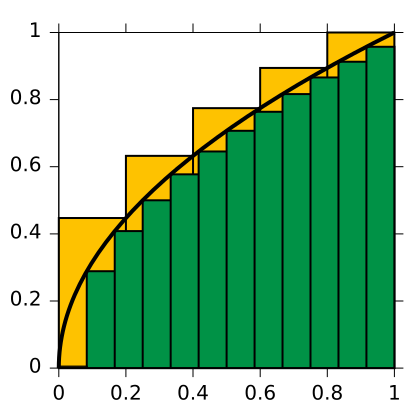
The reason I thought of this trick is because the idea of slicing up a sphere in lots of smaller pieces and adding them up reminded of the concept of an integral. Very rough explanation: An integral is something you can use to calculate the area below a curve. The idea is that you divide the area into small rectangles, whose surface is easy to find. The more rectangles, the closer you get to the exact value. See diagram to the right, which this time I didn't make myself in MS Paint but rather took from Wikipedia*. You're welcome. Anyway, the same principle can be used for volumes (and happens to be something I've been doing in class a lot, lately). The trick we need for today's problem is to go backwards from an integral. I'll explain how that works in a moment.
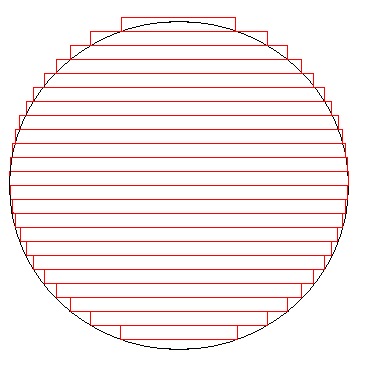
So let's go back to the beginning. You've got a sphere and many parallel slices, whose area you want to know. You already know the radius of the sphere , so you can easily find its volume as 4/3*pi*r^3. And then you think: "I have all these parallel slices at the same distance of each other. I bet that if I took each slice, made it into a cylinder, and stacked them all on top of each other I'd get something very similar to the sphere". You can imagine something like our 4th illustrative MS Paint diagram. The red is the stacked cylinders, black is the actual sphere (I know they look like rectangles on a circle, I don't feel like adding 3d effects and the idea is the same). Anyway, you can see that is a reasonable approximation, though of course not perfect. The more slices, the better the approximation, so for the ~100 slices of my original problem this is more than good enough.
So, you add the volumes of the cylinders and get a result that is close to the volume of the sphere. But what are you doing when you are adding the volume of the cylinders? Well, a cylinder's volume is height times area of the base. So we have base area of the first cylinder (ba1) times its height (h1), plus those of the second (ba2*h2), plus those of the third (ba3*h3)... But wait, all those h1, h2, h3 are the same, so we can just call it h. So we have: Volume of the sphere ~= ba1*h + ba2*h +ba3*h +.... The symbol ~= means "approximately equal".
With me so far? We have everything multiplied by h, so we can just write it as volume of the sphere ~= h*(ba1 + ba2 + ba3 + ba4 + ...). But what is this sum of ba's? The sum of the base areas of all the cylinders. And what is the base area of those cylinders? It happens to be the area of the circular sections we were trying to calculate in the first place!
So we just divide both sides of the equation by h, and we have that (volume of the sphere)/h ~= sum of the areas of the circular sections. And the volume of the sphere, I remind you, we already know from its radius. So this long explanation adds up to a very simple formula, which is the biggest advantage of this method: It's ridiculously easy to use. Just take r and h, and plug them in here:
 .
.
As for that "approximately", how approximate is it? In my original problem, radius = 150 m and h = 3 m, the result I got from my Python script is 4,711,917.9068 (pi to ten decimal places, just because that's as much as I know from memory). Using the formula above, I get 4,712,388.9804. That's an error of about 0.01%. So, y'know, pretty good. Considering the result I reported to the person who asked me was "about 4,700,000 m^2", far more accurate than I needed.
To my imaginary readers, I promise I will get back to writing fiction rather than math and shitty .bmps. Eventually.
*The image's copyright holder is Wikipedia user KSmrq. Since it's under a Creative Commons Attribution-Share Alike license, so is this individual post.
 |
| Image stolen from Wikipedia |
 | |
| Illustrative MS Paint diagram 4 |
So, you add the volumes of the cylinders and get a result that is close to the volume of the sphere. But what are you doing when you are adding the volume of the cylinders? Well, a cylinder's volume is height times area of the base. So we have base area of the first cylinder (ba1) times its height (h1), plus those of the second (ba2*h2), plus those of the third (ba3*h3)... But wait, all those h1, h2, h3 are the same, so we can just call it h. So we have: Volume of the sphere ~= ba1*h + ba2*h +ba3*h +.... The symbol ~= means "approximately equal".
With me so far? We have everything multiplied by h, so we can just write it as volume of the sphere ~= h*(ba1 + ba2 + ba3 + ba4 + ...). But what is this sum of ba's? The sum of the base areas of all the cylinders. And what is the base area of those cylinders? It happens to be the area of the circular sections we were trying to calculate in the first place!
So we just divide both sides of the equation by h, and we have that (volume of the sphere)/h ~= sum of the areas of the circular sections. And the volume of the sphere, I remind you, we already know from its radius. So this long explanation adds up to a very simple formula, which is the biggest advantage of this method: It's ridiculously easy to use. Just take r and h, and plug them in here:
.As for that "approximately", how approximate is it? In my original problem, radius = 150 m and h = 3 m, the result I got from my Python script is 4,711,917.9068 (pi to ten decimal places, just because that's as much as I know from memory). Using the formula above, I get 4,712,388.9804. That's an error of about 0.01%. So, y'know, pretty good. Considering the result I reported to the person who asked me was "about 4,700,000 m^2", far more accurate than I needed.
To my imaginary readers, I promise I will get back to writing fiction rather than math and shitty .bmps. Eventually.
*The image's copyright holder is Wikipedia user KSmrq. Since it's under a Creative Commons Attribution-Share Alike license, so is this individual post.
Monday, July 25, 2011
Evaluation: Countdown
Been a while since I wrote one of these. Laziness really, though I have been working on stories.
Countdown is yet another Vurok story, it revises a bit of Void's backstory. It's after he discovered his powers, and after he went Pather, but before he met Ananke and became Void. Which means I'll be revealing his name! His surname, at least.
I have written 594 words so far, and I have an intro to add to it and some bits to revise, but I've been lazy about it. I don't have much in terms of stuff to do this week and the next, so I'll have a chance to work on it later.
But there's more! Though not technically a story, I'm working on yet another Psychflare simultaneously. It's called On the Nature of the Common Vampire, and it's basically an extensive description of Vurokian vampires, framed as a reference book. Yes, there are Vurokian vampires. No, I hadn't mentioned them before. I had a very specific idea for vampires for some fictional setting, I figured a way they'd make sense in the Vurokverse, so I decided to throw them in. Because, hey, why not.
ONCV stands at 1308 words in length. So yes, I've put more work into it than into Countdown, but the latter got the evaluation title because I started it first and it's the one that's actually a story rather than worldbuilding material.
Wednesday, July 13, 2011
Psychflare: Fehu
Fehu
The night had begun, as many do, at this little pub called Midpoint. It's more or less the same distance from the clubs east of Twenty-Third and those south of Twelth, which I guess is the reason for the name. Never asked. And, as usual, we were trying to decide whether to go east or south.
Marie wasn't around tonight, which skewed things against south. She needs to get high or drunk or something given half the chance, so she's always the biggest advocate for heading towards the less-monitored area and buying pill-shaped fun. Nobody knows how she manages to hold a job. But, on the other hand, Gianna wasn't being her usual self either. Bad breakup, taking a break from being the voice of reason, etc.
I didn't have a strong opinion either way, nor did most of the rest. I think, if I had mentioned I was always a bit uncomfortable down south, I could've decided things right then, but I didn't. Maybe apathy, maybe not wanting to “admit weakness”, point is, I didn't say a word, someone else said she wanted something a little more exciting than the places east, and we went.
It was nothing out of the ordinary, for the most part. We ran across Joshua and bought his latest brain-fucker, most of the girls found halfway-decent guys to get laid with (I didn't), and by five or six I was sobering up and had lost track of everyone else. So I decided to head back home.
It was a short walk to the bus stop, maybe three or four blocks. Sure, not the safest area to be around, but I had been here a thousand times, nothing to be afraid of, right?
Wrong. Two guys, smashed as fuck-all and feeling overly friendly, were making their way towards me. And presumably talking to me, though I couldn't understand a word they were saying. I wasn't exactly wearing running shoes, but for some reason it felt like a good idea to get the fuck out of there quick.
I tripped. I fell. And the creepy bastards were almost right behind me, when shit got psychedelic.
I thought the drug's effects should have worn off a while ago, but they had come back in full force. Different this time, though. I didn't feel overexcited and willing to do anything, but I wasn't terrified as a moment ago either; whatever I was feeling right now, it was entirely new. The world didn't fade out and blur, but the opposite. It became more.
It's hard to explain if you haven't been through it yourself, like I had developed a new sense and it was superposed to vision. I was seeing things that weren't shapes or colours or anything you should be able to see, mixed in with the street and the buildings and the cars and...
The people. The animals. My two stalkers, a dog running down the street, the cat it was chasing... anything that was alive was glowing without light. Patterns twisted and turned, as I noticed the not-light was brightest around me, full of possibility...
That was it. That was what the strange new feeling, the sheer force of potential, being able to do anything if I could just shape the patterns the right way. I saw, or felt, lines connecting a million tiny dots all over the place. I didn't think, I just reached out, rearranged a dozen lines, as much with my fingers as with my thoughts.
I crashed back to plain reality, only to notice the two guys going at each other. They were ripping the clothes of each other's bodies, and by their looks I couldn't tell if they were about to make out or beat the shit out of each other, or both. I didn't stay and watch.
* * *
I spent most of the day tracking Joshua down through a couple common acquaintances we had. During the process of calling everyone I knew who knew him, I gathered that nobody had went through the cool delayed effect trip I had, or at least hadn't mentioned a word about it. Sometime late afternoon I got ahold of him.
“Josh? It's Kel.”
“Marie's friend, right?” he replied. “What's up?”
“Uh, it's about what you sold me last night-” I started, but he interrupted me.
“Look, whatever that shit did to you, I'm not responsible, kay? I don't mix 'em, I just sell”
“I know, I know. I was just wondering if you had any more left.”
He paused for a second “Yeah, think so. Drop by my place tonight...”
He gave me an address, half an hour away or so, then hung the phone. I sighed in relief. I knew that new pills were not mass-produced. The labs or whoever designs them pumps out a dozen chemicals a month, do just enough basic testing to know they won't kill you immediately, then give a few samples to dealers like Joshua to see what's popular. It makes for interesting experiences, but also it meant I was lucky that he didn't exhaust his stock last night, or I might never find them again.
I wasn't exactly swimming in cash, but I could afford a little extra fun this month. Depending on how much Joshua had left, I might even buy him out... fuck. Was I sliding down the junkie slippery slope? I had never felt this way after a trip, ever. And I didn't know if it was good or bad.
A couple of hours later, I was taking the bus down to his apartment. Short trip, like I said, but it was oddly uncomfortable. Being around people felt oppressive. Maybe I was self-conscious, it was really the first time I went out specifically to meet a drug dealer. I just used once or twice a month if that, always prompted by friends, I didn't stockpile for personal use.
Deliberations along those lines continued (unproductively) until I found myself in front of the door of a typical apartment building waiting to be buzzed in. A short elevator trip, a walk down the hallway, and a knock on a door marked 5D later, my uneasiness had abated somewhat, though not completely.
Joshua opened the door and motioned me to come in. We got down to business immediately.
“This is the one you asked for,” he said as he showed me a small plastic bottle with a few numbers and letters in the label.
“What's it called?”
“Nothing, as far as I know. They give them an identifying code to keep track of what sells and what doesn't, this here is NH589R. The funky names like Zerri or Phyt they choose once they prove popular.”
“And before you ask,” he continued, “no, I can't tell you who “they” are or how to contact them.”
“Didn't expect you to,” I replied. “Though, I do have one question, if you can answer.”
“Yeah?”
“About an hour after I thought the effects had worn out, I got a second high, though it wasn't quite like the first. More the hallucinatory-consciousness-expanding type, if you know what I mean”
He nodded. “I get the idea, though I dunno why it happened to you. Nobody said anything about that, users or suppliers”
“Damn. So, what, I have a weird neurochemistry or something?”
“You're asking the wrong person, kid, I dropped out halfway through my chem degree. I'll be passing the message along, though, maybe they know something.”
“Maybe. Anyway, how much for the rest of your stock?”
“All of it?” He asked incredulous.
I could almost feel his glee when I nodded
* * *
So I was the proud owner of a highly expensive, three-quarters empty bottle of something, which, as far as I knew, only worked its magic on me. Well, the most interesting half of it, anyway. It's curious, but up until that point I hadn't noticed how the idea of never finding that same sensation again had pressed on my mind. Returning safely home with that bottle in my possession was a relief from a weight I didn't realise I was carrying.
But, once that concern vanished, the smaller ones it had driven away returned. The one thought I had been avoiding manifested freely. Namely, what the hell had happened to those two guys?
No drug can fuck other people up just by being too close to you. And it was too much of a coincidence for them to just go crazy at the same time I'm having the weirdest trip of my life. Not to mention... well, I don't know how much I can trust my memory, but it felt like I was expecting them to go crazy. Like I knew that the twisting lines in the air meant they were about to... what? Rape each other? I didn't know, and yet I felt like I had known.
Had it all been a hallucination from the beginning? But the trip had only started after I fell to the ground running from them. They were real. And if what I saw had only happened in my mind, then what had actually happened? What had they done, while my imagination ran wild?
The thought was revolting. No. No, I would have noticed. The idea made no sense. Nothing made any sense at all. I didn't want to think about it, but it was stabbing through my brain. And, right in front of me, I saw an escape from the world, and took it.
I'm not sure how much time I spent in vacuous bliss, a few hours at the most, before the buzzing interrupted it. Shit. I was in no condition to deal with people.
A quick look told me it was Marie. Well, at least she wouldn't judge me too harshly. I opened the door and mumbled something which might have passed for a greeting, then led her towards the living room.
“Josh told me you paid him a visit earlier.”
“Yes, I bought his stuff. Yes, I'm high right now. No, I'm not interested in talking about it. Lovely chat, bye...” I tried to laugh, but it sounded off.
“Kel... Look, I'm not a hypocrite. We all need a break every once in a while, some more often than others. Maybe you've got some crap in your life, it happens. But there are some lines you need to watch out for, y'know?”
Lines. I should watch out for lines?
“I didn't think I'd find you like this, this is hardly the time to have a talk... but at the same time, it makes it even more important. I need to make sure you aren't spiralling into-”
“You're worried.” The words came out of my mouth before I could think.
“Of course I'm worried. You can't just spend I don't know how much on drugs and expect-”
“But you're also excited” I interrupted her again. “You think this is... an opportunity? And guilt, too, I can see guilt. You think I'm in trouble and you shouldn't be thinking about yourself. And... what else... confusion, but that's new.”
“What are you talking about?”
“You told me to watch out for lines...” Suddenly, I became conscious of what I was saying. The hell?
“Sorry, don't pay attention to me” I apologised. “It's my fucked-up brain talking. You're concerned, and I appreciate it. Tomorrow I'll be... sane, and we can have this talk, ok?”
“I shouldn't leave you alone...”
“Probably not.” If you go, the lines go with you, I wanted to say. The lines that were right at that moment dancing around her head.
* * *
Marie stayed the night, and we had a long talk in the morning about limits and “responsible” use of recreational drugs and not spending thousands in one night. I did my best to reassure her that it was a one time thing without going into details, and I think I succeeded. Perhaps because, throughout the entire conversation, her emotional state was dancing right in front of me. I didn't know why the lines and symbols were there. I didn't know why I could understand them. But I knew exactly what she was feeling. Or at least that's what a nudging intuition kept telling me.
The sense wasn't the same. Last time, I'd felt a raw force of potential which did not return. Not while I was high, not at any point in the hours afterwards, not while I talked to Marie. It was disappointing, to say the least.
And even what remained of the experience was different. The lines had changed. Less of them, for one, but I also perceived them in another way. More visual in nature, not quite that alien sense I'd felt. What they connected was no longer points of pure meaning, either, they were... symbols, maybe. I had to interpret them, though I didn't know how I did it.
And on reflection, that light that wasn't light was still there, but dimmer, less stark. Everything had been dialled back a few levels of awesome, though mundane reality still lost by far by comparison. In exchange, the effect was much longer lasting, hours instead of seconds. I had no idea what to make of it.
I had expected to understand more about what the hell the drug did after the experience, but no. If anything, I was more confused than before. Twice so far, whatever it was had given me the illusion of something supernatural going on, and maybe it was a sign of me losing my mind, but I couldn't rule out that it had actually happened. Imagining you can guess someone's emotional state wasn't that impressive, when I thought about it, especially since I had no way to check if I was right. But, what had happened the first time...
Shit, I was back where I started. I'd managed maybe half a day without thinking about it and now there it was again. I tried not to flee the thought, to stare at it and think, maybe something would make sense of it all, but nothing concrete came to mind. I needed to know more.
Thus, the rest of the day was dedicated to research. OK, calling it research might be a bit too much. I just went online looking up references to “NH589R” or something like what I hallucinated either time. No luck, of course. I gave up eventually, and went to bed early. I had to work the next day, after all.
* * *
6 am. Woke up, brushed teeth, took a shower, got dressed, downed a quick coffee, and left. Got on the bus, and a vague oppressive sensation creeped up on me. It was... I knew what it was. I'd felt it before, when I was going to Josh's apartment. I'd thought I was just being self-conscious back then, but why was it here now? And why was it growing and growing and...
All of a sudden, everything was happening at the same time and I could see the lines everywhere and they danced and moved and there were too many of them and I crashed. Sensory overload blasted me. Next thing I knew, people were helping me up and someone gave me their seat while I tried to hold back a flood of information from everyone around me. It thankfully receded after a minute or so, but it didn't vanish. It was always there, just more or less manageable.
It was not a fun morning. What I really needed was to be away from any living human being for a while to let my head recover. What I got was hours of people whining about how them, their friends, or their family were sick and possibly going to die. That was annoying even before I had to feel the cacophony of worry and fear and boredom (mostly boredom).
I survived it, somehow. The bus ride back was excruciating, but I managed not to collapse until I got home, at which point I isolated myself from the world. And that was the first day.
* * *
Two weeks. Two goddamn weeks of constant headaches and mood swings and not being able to stand close to anyone without being overwhelmed within five minutes. Of running away from everything and everyone at the earliest chance because the alternative was to snap. It was fucking intolerable. It was such torture that I wanted to just no care about anything, to be entirely numb so I could ignore them, put them away for long enough to regain my sanity.
I didn't know how long I would last. I hoped, given enough time, I'd figure something out, but the easy way out was becoming more and more tempting. If nothing changed... but then, something did.
It was at work, while I tried to explain to a concerned woman (unsuccessfully trying to hide her fury) that no, her husband wasn't here and no, I didn't care about her marital problems. I caught a glimpse of something. Someone. A man covered in a cloud of swirling, glowing gas which no-one paid much attention to.
He was looking directly at me, and when he saw I'd noticed him, winked. Then he vanished. That is, he literally disappeared into nothingness, and the cloud followed shortly afterwards. A few people were surprised by that, but soon forgot about it or assumed it was their imagination or a trick of the light or some other perfectly mundane explanation for short-lived unexplained weirdness. I could see them squash their confusion away from their minds.
An hour later or so, as I left work and walked to the bus, the vanishing man reappeared. I was understandably startled.
“Shit!” I stared at him. He was definitely the same guy. Tall, dark-haired, smug expression, and dressed entirely in black. He appeared to be in his late twenties, and still had that swirling cloud covering him. “Who the fuck are you?”
“Such manners. But, to answer your question, my name-” He made an elaborate gesture and pulled a card out of nowhere, “-is Reykur the Illusionist.” The card suddenly combusted, and the smoke spelled out “REYKUR”. “It's not often I find a fellow practitioner, so I wished to introduce myself to you.”
“Right. Of course.” As if I wasn't having a bad day already, now I had to deal with a mental patient with a thing for magic tricks. “Sorry, but I think you confused me with someone else.”
“No need to be secretive, my friend. I can feel it, the way you read the souls of those around you. As, I'm sure, you can feel the traces of my own talent in some form.”
Read the souls... wait. I could do something that might be described like reading souls. And, I noticed a second later, I wasn't getting anything from him. For the first time since that night with Marie, I wasn't seeing the emotions of someone who was right in front of me.
“It won't work on me, so you can stop trying” he grinned.
“You can block it? You can block it?” I almost yelled. “Why? How?!”
“My, why so shocked? Yes, I can block your talents, and many others can, as well. You're not that powerful”
“No, it's not that... I mean, do you know if I can block it? Can you tell me how?”
Again with his grin. “Follow me. I believe we have a lot to discuss”
I was hesitant, to be honest. The guy didn't exactly seem trustworthy (or entirely sane) and for all I know he could be leading me anywhere. On the other hand, this might be my only chance to learn more about what had happened, and it seemed there was a lot more to learn than I had suspected at first.
So, dreading what could come, I nodded and walked after him.
“You're new to your talents, clearly. How long ago was your first Trance?”
“Trance?”
“Ah, of course, you wouldn't know the term. The Trance is an altered state of mind, in which reality itself appears to unravel before your eyes, letting you twist it to your whim, making the impossible real,” he declared. “We go through it for the first time when our talent awakens”
“Oh. That. It was about two weeks ago...” and the rest of the tale followed.
He paused to digest the story. “The manner of manifestation of the Trance determines which talents come natural to you. Oh, you can learn other tricks, to be sure, but you'll always be at your best with those that came to you in a Trance.”
“So the first thing I did was... manipulate those guys' emotions? And so my talent relates to that?”
“Indeed. Of course, you are too inexperienced to do much with it, so that's why you're just receiving instead of controlling, at the moment. With some practice...” He left the sentence hanging.
“That's all great, really, but what I need right now is to make it shut up.”
“Yes, you've made that clear.” He stopped suddenly and turned to face me. “I have business to attend to right now, but we'll continue this conversation. Meet me at this very spot, at midnight. Do not talk to anyone about this, do not draw attention to yourself... and do not be late” and in puff of smoke, he vanished again.
* * *
I didn't know what to make of “Reykur”. Not just his dramatic tendencies, annoying as they were, but more the fact they felt like a mask for something. I mean, someone who could vanish at will? I could think of many obvious applications of that talent, most of them unethical at best, and he had hinted at having even more tricks than that. Plus that veiled reference to “business” wasn't reassuring either.
If I had an actual choice, all of this might matter. As things stood, at best I could decide to be careful around him. Staying the hell away, as part of me desperately wanted, was not on the table. And so, there I stood, right where he'd left earlier in the day. One minute to midnight.
Of course, he appeared out of nowhere. I'd probably have a heart attack if I hadn't been expecting it.
“Ah, good, you're here. My apologies for the late hour of the meeting, but I assumed you wanted to get started as soon as possible”
“Yeah,” was my reply. “So, what exactly are we getting started with?”
“Your initiation in the mystic arts.” He smiled. “Or, if you prefer, we can call it 'magic training'”
Subscribe to:
Posts (Atom)


